
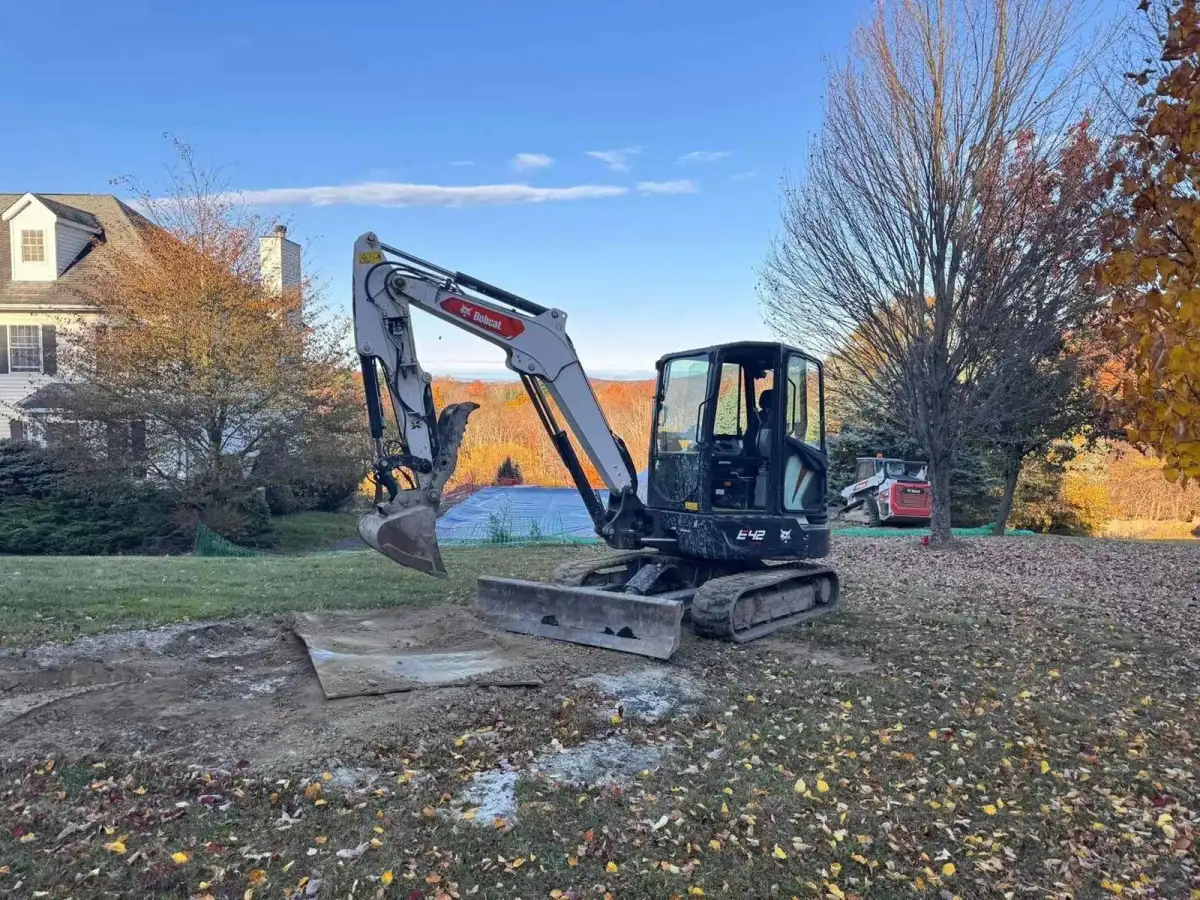
There is no honest one-number answer for residential excavation cost. A small, open dig with easy truck access is a different job from the same-size work area behind a narrow gate, below a slope, or in ground containing rock, wet soil, old concrete, roots, or buried debris.
A useful estimate begins with what must be removed and the finished result you need. It then accounts for how equipment reaches the work zone, where excavated material goes, what new material comes back in, and what must be protected or restored. That is why photos and square footage can start a conversation, but a site review is usually what turns it into a reliable price.
How an excavation estimate is calculated
1. Define the work limits and finished elevation
The contractor first needs to know what the excavation is for. A patio base, pool dig, retaining wall, drainage trench, failed-concrete removal, and lawn regrading all require different depths, tolerances, material handling, and finish work. Marking the work area and understanding what comes next prevents an estimate from being based on the wrong end result.
2. Estimate the amount of material to move
For a simple rectangular area, length multiplied by width and average depth gives an early volume. Real yards are rarely that simple. Slopes, changing depths, foundations, existing base material, buried obstructions, and irregular edges require field measurements and judgment. The estimate should also distinguish material that can remain on site from material that needs to be loaded and removed.
3. Match equipment and labor to the access
An excavator has to reach the work zone, move safely, and load material without damaging what is staying. Gate width, side-yard clearance, overhead wires, trees, walls, septic components, irrigation, driveways, and soft lawn areas can determine machine size and travel path. Smaller equipment may fit tight access but can require more trips and handling. Some areas may also need careful hand work.
4. Account for hauling, disposal, and imported material
Digging creates a material-handling question. The scope should say whether soil, old base, broken concrete, rock, roots, or other debris will be stockpiled, reused, or hauled away. It should also identify stone, clean fill, topsoil, or other material being delivered for the next phase. Loading, truck access, transport, and disposal can be a meaningful part of the total even when the excavation footprint is modest.
5. Include grading, drainage, protection, and restoration
The lowest excavation number may stop when the hole or trench is open. A complete scope may also need grade control, base preparation, compaction, drainage stone or pipe, stabilization, cleanup, and repair of the access route. Before comparing proposals, ask what condition the work zone and surrounding yard will be left in.
Why two excavation quotes for the same square footage can differ
Square footage describes the surface. It does not describe the job below it or the route to it. Consider three work areas with the same dimensions:
- Open lawn with direct access: equipment and trucks can stage close to the work, and removed material has a clear path out.
- Tight side yard: a narrow gate, finished patio, fence, or planting beds limit machine choice and require more protection or handling.
- Sloped or difficult ground: rock, wet soil, old fill, roots, concrete, or changing grades increase digging time and may change the drainage or hauling plan.
The surface area is equal, but the equipment time, labor, trucking, risk, and finish work are not. A useful proposal explains those differences instead of hiding them behind a single line labeled “excavation.”
Why excavation can cost more than expected
The excavator is only one part of the operation. Mobilizing equipment, protecting access, operating around structures, loading trucks, transporting and disposing of material, bringing in stone or soil, setting grades, managing water, and restoring disturbed areas all require labor and coordination. Unexpected subsurface conditions can also slow work that looked straightforward from the surface.
This is why a very low allowance deserves questions. Ask what happens if the crew encounters rock, buried concrete, unsuitable fill, wet ground, roots, or more material than expected. A clear proposal should state the included scope, known assumptions, exclusions, and how changed conditions are handled before extra work begins.
What to compare in excavation proposals
Put each written estimate beside the same checklist:
- Work limits, target depths, and intended finished elevation
- Equipment and known access requirements
- Items being removed and items that will remain
- Loading, hauling, disposal, and any assumed quantities
- Imported base stone, clean fill, topsoil, or drainage material
- Rough grading, finish grading, compaction, and stabilization
- Protection and restoration for lawns, drives, walks, fences, and planting areas
- Utility-marking responsibilities and known site constraints
- Cleanup, exclusions, allowances, and changed-condition pricing
An hourly rate is not automatically cheaper or more expensive than a fixed project price. The better comparison is the expected complete cost and how clearly the contractor has defined what is—and is not—included.
Newburgh-area conditions that can affect the scope
On Newburgh-area properties, slope, clay-heavy soil, freeze-thaw movement, aging concrete, and runoff can affect excavation depth, finished elevations, access, and where water should go. Those conditions do not create one citywide price. They make it important to review the actual work zone before relying on a general number.
Lawn Spa Landscaping provides excavation and site preparation across its Hudson Valley service area. For work in New Windsor, Cornwall, Beacon, Fishkill, Wappingers Falls, and the other listed communities, municipal requirements and site conditions should be considered as part of the proposal rather than assumed from the town name alone.
Connect the excavation price to what comes next
Excavation is usually groundwork for another result: a stable patio base, a pool at the correct elevation, room for a retaining wall, a drainage trench that reaches a suitable outlet, or a yard ready for topsoil and seed. Pricing the dig separately from that result can create gaps between contractors or lead to rework.
If your project also involves drainage, a retaining wall, pavers, or pool installation, ask how depth, grade, access, and restoration will be coordinated. The right excavation scope should leave the site ready for the approved next phase—not simply leave less dirt in the ground.
To request a site-specific number, send Lawn Spa the property town, the project goal, rough dimensions, photos of the work area and access route, and any known water, soil, or buried-obstacle concerns. Request an excavation estimate or call (845) 467-0845.
Common Excavation Price and Estimate Questions
There is no dependable flat excavation rate for every yard. Contractors may quote a fixed project price, an hourly equipment-and-crew rate, a unit price, or a combination. The total should account for the work area and depth, access, soil conditions, equipment, labor, hauling or disposal, imported material, grading, protection, and restoration.
Start by defining the work limits, target depth, and finished elevation. From there, estimate the amount of material to remove, machine and crew time, loading and hauling, disposal, imported stone or soil, drainage work, access protection, cleanup, and restoration. A site visit is usually needed to turn those inputs into a reliable price.
The visible digging is only part of the job. Excavation can also require equipment transport, skilled operation, hand work near obstacles, loading, trucking, disposal, stone or topsoil, grade control, drainage, protection of existing surfaces, cleanup, and restoration. Tight access, rock, wet soil, old concrete, roots, or buried debris can add time and handling.
Either method may be used. A defined scope may be quoted as a fixed project price, while uncertain or open-ended work may use hourly or unit pricing. Compare the written scope, allowances, exclusions, and change conditions instead of comparing only the pricing format.
Provide the property town, project goal, rough dimensions, desired finished use, photos of the work zone and access route, known drainage or soil concerns, gate widths or overhead limits, existing surfaces that need protection, and any plans tied to a pool, patio, wall, trench, or lawn restoration.