
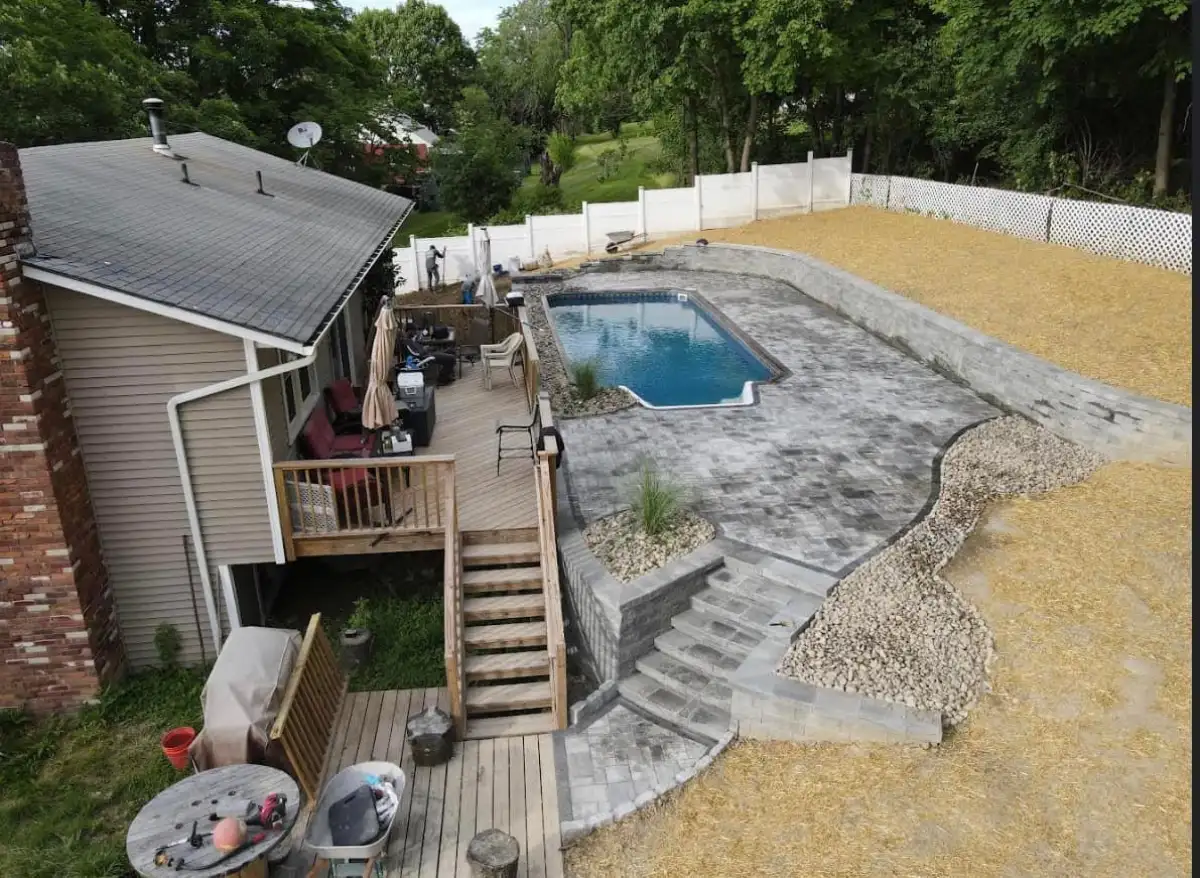
A good paver decision starts below the finished surface. Pattern and color matter, but the long-term result also depends on the proposed use, excavation, subgrade, base, pitch, edges, joints, and water movement.
Those details are especially worth discussing on Newburgh-area properties, where slopes, runoff, winter freeze-thaw cycles, and existing grades can affect the scope. Before booking paver installation, use the questions below to compare proposals on the same terms.
1. What will the paver surface be used for?
A front walk, dining patio, pool surround, step system, and vehicle area do not place the same demands on a paver assembly. Tell the contractor how the space will be used, where furniture or equipment will sit, and how it needs to connect to doors, driveways, pools, lawns, or retaining walls.
Ask whether the proposed paver product is intended for that application. Thickness, dimensions, texture, edge profile, and surface finish should be selected for the use—not only for appearance.
2. Can pavers be laid directly on soil?
For a permanent patio, walkway, or pool surround, pavers are generally installed as part of a prepared system rather than placed directly on soil. The proposal should describe excavation, the exposed subgrade, compacted base material, bedding, edge restraint, joint material, and final pitch.
Ask what happens if excavation reveals soft, wet, disturbed, or otherwise unsuitable soil. A clear answer should explain how the condition will be evaluated and how any scope change will be approved before extra work begins.
3. What is the best base to put under pavers?
There is no single base depth or aggregate specification that fits every property. The suitable design depends on the exposed subgrade, intended load, selected paver system, manufacturer guidance, compaction approach, and drainage conditions.
Instead of asking only for a depth, ask the contractor to identify the proposed aggregate, how it will be placed and compacted, what bedding will be used, and how the edges will be restrained. The answer should connect the base plan to the actual site rather than repeat a one-size-fits-all number.
4. Where will water go after the project is built?
A finished paver surface needs deliberate elevations and pitch. Ask where runoff travels now, where it is intended to go after construction, and whether roof discharge, nearby slopes, low spots, pool coping, walls, or neighboring surfaces affect the plan.
The City of Newburgh's stormwater program underscores the importance of managing runoff as a property-wide issue. If standing water, erosion, or wet soil is already present, the paver plan may need to be coordinated with drainage solutions rather than treating water as an afterthought.
5. How should I compare paver products and material prices?
Compare the exact product line, not just a manufacturer name or a price per square foot. Record the dimensions, thickness, finish, texture, intended application, pallet coverage, delivery, lead time, replacement availability, cleaning guidance, and written warranty terms.
The cheapest place to buy pavers may not produce the lowest completed-project cost. Material quotes can exclude delivery, waste allowance, cuts, excavation, base materials, labor, edges, joints, drainage, disposal, and site restoration. Our Hudson Valley paver patio cost guide explains the variables that commonly shape an installed estimate.
6. How can I compare reputable paving companies in Newburgh?
First confirm that each company installs the kind of surface you want. Asphalt paving and segmental paver installation are different services. Give each contractor the same project description and compare the written scopes line by line.
Look for specific treatment of demolition, excavation, subgrade conditions, aggregate, compaction, bedding, pitch, drainage, cuts, borders, edge restraint, joint material, access, cleanup, restoration, substitutions, changes, payment timing, and warranty terms. Verify current insurance and any relevant credentials directly rather than relying on a general claim.
7. What maintenance should I expect?
Routine care commonly includes removing debris, cleaning spills promptly, monitoring joints and edges, and addressing rocking pavers or drainage issues before movement spreads. Ask which joint material is proposed and what maintenance it may need over time.
Cleaning products, pressure-washing methods, de-icing products, and sealers should be compatible with the specific paver. If sealing is discussed, ask what the product is intended to do, when it can be applied, how the surface must be prepared, and what future reapplication may involve.
A short checklist before you book
- Confirm the exact paver product and its intended application.
- Review excavation, base, bedding, edges, joints, and compaction in writing.
- Identify finished elevations, pitch, runoff direction, and drainage connections.
- Clarify access, demolition, disposal, cleanup, and lawn or planting restoration.
- Understand how unexpected soil conditions and other changes are approved.
- Keep product guidance, warranty terms, and maintenance instructions with the proposal.
A complete comparison does not require every contractor to recommend the same system. It does require enough detail to understand why each recommendation fits the property and what is included in the price. If the project also involves steps, walls, masonry, or outdoor-living connections, review Lawn Spa's broader hardscaping services before requesting an estimate.
Answers to Common Newburgh Paver Questions
For a permanent patio, walkway, or pool surround, pavers are generally installed as part of a prepared system rather than placed directly on soil. The appropriate excavation, compacted base, bedding, edge restraint, joints, and drainage details depend on the intended use, selected product, and site conditions.
There is no single base specification for every property. The design should account for the exposed subgrade, intended use, selected paver system, manufacturer guidance, compaction, and water movement. Ask the contractor to state the proposed assembly and how unsuitable soil will be handled.
Confirm that each company installs segmental pavers for your type of project, then give each one the same information. Compare written proposals for excavation, base preparation, pitch, drainage, edges, joints, cleanup, restoration, changes, and warranty terms. Verify current insurance and any relevant credentials directly.
Routine care commonly includes removing debris, cleaning spills promptly, monitoring joints and edges, and correcting rocking pavers or drainage issues before they spread. Cleaning products, pressure washing, joint material, and sealer should be compatible with the specific paver product.